Jazz Transcription
“Waiting on a Friend”
Joshua Redman, tenor saxophone · With The Rolling Stones · St. Louis, 1997
About this performance
“Waiting on a Friend” was first recorded for The Rolling Stones' 1981 album Tattoo You, featuring a legendary solo by Sonny Rollins. For this 1997 live performance in St. Louis, The Rolling Stones invited Joshua Redman on stage to take the saxophone spotlight.
This performance can be heard on The Rolling Stones' 1998 live album No Security. Redman's solo masterfully walks the line between jazz and pop, blending grace notes and bends with traditional bebop vocabulary. He also pays homage to the original soloist with an ingenious quote halfway through.
Personnel
- Joshua Redman — tenor saxophone
- Mick Jagger — vocals
- Keith Richards — guitar
- Charlie Watts — drums
- Ronnie Wood — guitar
Articulation as motif
This solo is a showcase of articulation brilliance. Articulation, along with time-feel, serves as a musical fingerprint — no two players articulate exactly the same way. For this reason, articulation may be one of the most challenging musical elements to notate with clarity.
While I've added some articulation markings, I encourage you to study the recording to fully appreciate Redman's particular approach rather than relying solely on the notation.
Articulation example 1

This simple yet rhythmically complex phrase owes its catchiness and memorability to Redman's articulation. He creates interest and motivic continuity by alternating between long and short note lengths.
Articulation example 2
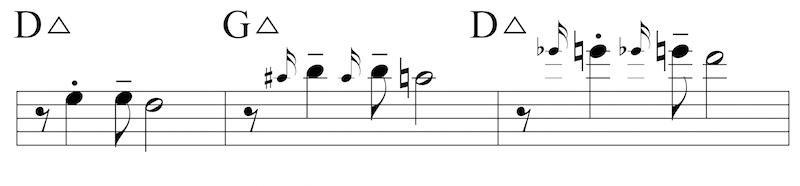
Another remarkably catchy three-note phrase. Redman excels at building entire solos from basic musical elements (as does Sonny Rollins). This particular phrase employs varied articulation, tension and release, and expressive grace notes.
Articulation example 3

This line features several articulation techniques along with varied note lengths and motivic development. My favorite aspect is how Redman pushes and pulls on the time — stretching the two eighth notes on beat one of the third measure with a laid-back feel, then contrasting that with staccato eighth notes immediately after.
Descending 7th chord figures
Another notable technique is Redman's use of descending 7th-chord-like figures. While he doesn't overdo it, the pattern appears frequently enough to be considered part of his vocabulary.
He most often plays a descending E minor 7th chord, typically followed by some variation of an A7 chord. This creates harmonic motion (ii–V) leading to the home key of D major in an otherwise harmonically static song.
Redman also plays several other four-note descending arpeggio-like sixteenth-note lines — often inversions of triads, 7th chords, or pentatonic scales. These descending sequences are a defining characteristic of this solo.
7th chords, example 1 — implying ii–V on static harmony

Here, Redman plays this motif over three consecutive beats. The first two beats show the “7th-chord-ish” variety: beat one is a G triad, and beat two is an E minor triad starting from the 9th. Beat three presents a clear E minor 7 chord descending from the 7th, while beat four implies A7. Combining the E minor 7 on beat three with the A7 on beat four creates a ii–V resolution to D major.
7th chords, example 2

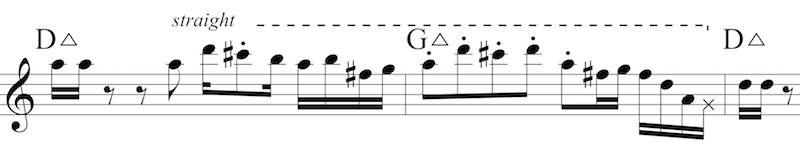
This example features multiple Redman techniques. Beat three of the first measure shows an enclosure of the G major chord on beat four — this harmonic anticipation creates forward motion. The next three beats demonstrate descending 7th chords: beat four is a first-inversion E minor triad (or E minor pentatonic variation), beat one of G major is a descending Gmaj7 chord, and the following beat is an E minor 7 permutation. This phrase also highlights Redman's effective grace-note technique.
7th chords, example 3

The final appearance of this descending E minor 7th chord comes at the very end of the song, just before Redman's short cadenza on the final chord.
The “St. Thomas” quote
In a brilliant moment during his second solo, Redman pays tribute to Sonny Rollins — the original soloist on this song. About halfway through, we hear Redman quote Rollins' most famous composition, “St. Thomas.”
What makes this moment remarkable is the musicality with which it's executed: the quote fits seamlessly within the surrounding context, something that's notoriously difficult to achieve with any musical quotation, even when completely spontaneous. Rollins himself is renowned for quoting melodies and tunes in his improvisations, making this a fitting tribute. Interestingly, both songs are in the same key (C major).
[Diminution is] a form of motivic development using rhythmic embellishment where all (or most) of the note values of a motif are contracted or decreased by a noticeable amount in a subsequent motif. The melody notes and melodic curve usually stay the same, but may change. Hal Crook, How to Improvise
Redman applied a motivic-development technique known as diminution when quoting “St. Thomas” — compressing the rhythmic values while maintaining the melodic contour.
Rollins' “St. Thomas” (original)
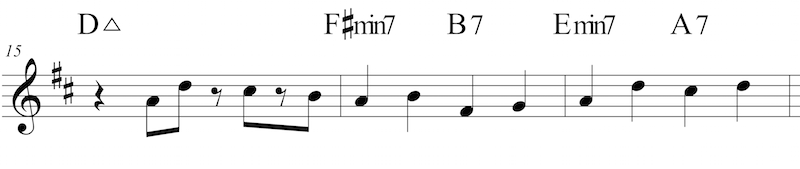
Redman's quote (diminution)