Artist Advice
Thelonious Monk's Advice to Steve Lacy
25 pieces of advice, transcribed in 1960
Saxophonist Steve Lacy wrote down this list of advice from Thelonious Monk in 1960, the year he briefly played in Monk's band. Two years earlier, Lacy had recorded Reflections — the first non-Monk album of all-Monk compositions — with Mal Waldron, Buell Neidlinger, and Elvin Jones; he later appeared on Monk's Big Band and Quartet in Concert (Lincoln Center, 1963).

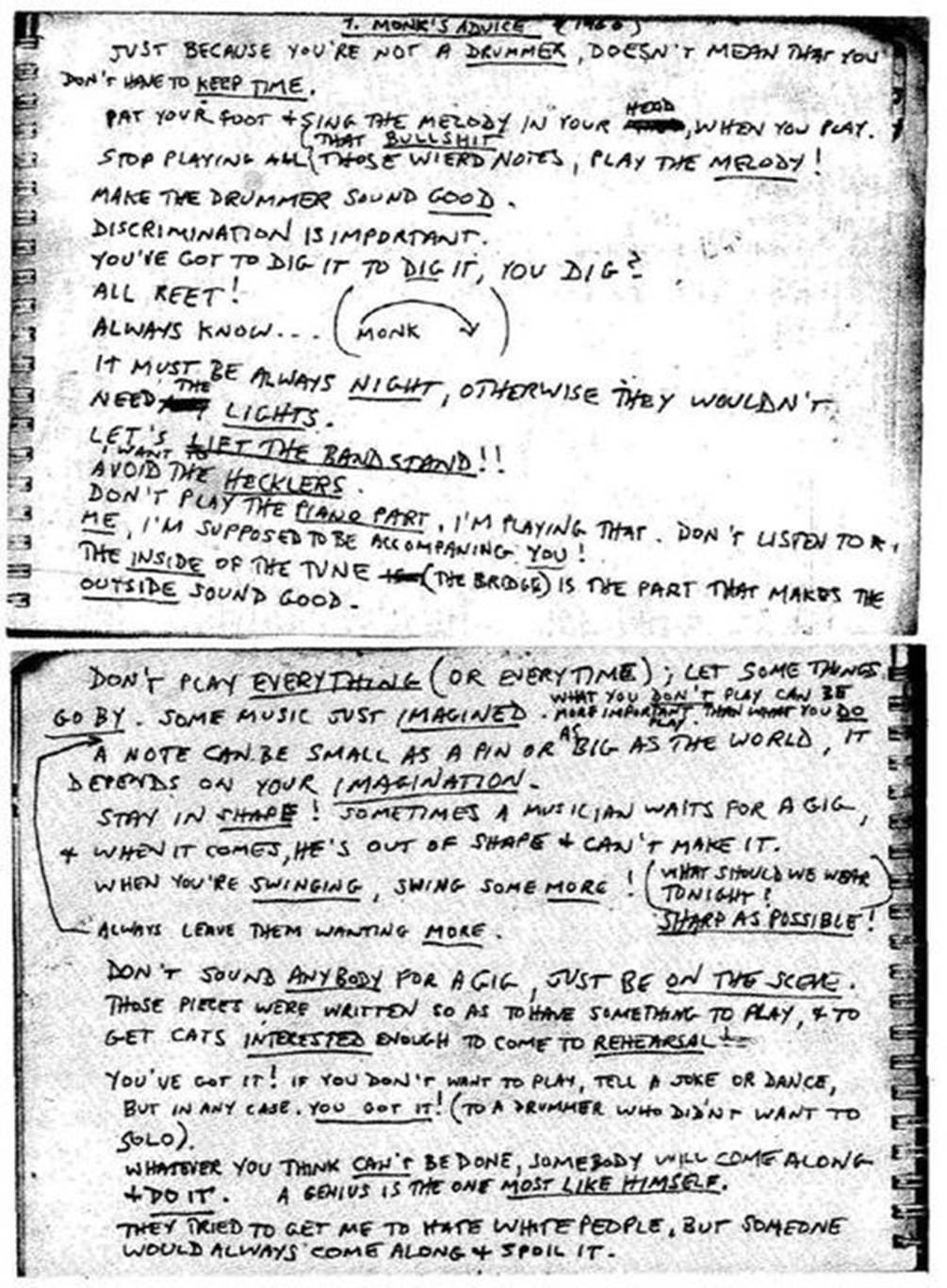
The 25 Pieces of Advice
- Just because you're not a drummer, doesn't mean you don't have to keep time. Every musician is responsible for the groove, not just the rhythm section.
- Pat your foot & sing the melody in your head, when you play. Internalize the music physically. Your body should feel the pulse.
- Stop playing all that bullshit, those weird notes, play the melody! The melody is sacred. Always serve the song first.
- Make the drummer sound good. Great musicians lift each other up. Play to support, not to impress.
- Discrimination is important. Be selective. Not every note needs to be played; choose wisely.
- You've got to dig it to dig it, you dig? You can only understand something you truly love and invest yourself in.
- All reet! Jazz slang for “All right!”—an affirmation.
- Always know… A fragment, but the implication: always be aware, always be prepared.
- It must be always night, otherwise they wouldn't need the lights. A poetic observation about the jazz club atmosphere.
- Let's lift the band stand!! Bring energy. Elevate the performance.
- I want to avoid the hecklers. Don't give critics ammunition. Play with conviction.
- Don't play the piano part, I'm playing that. Stay in your lane. Each instrument has its role.
- Don't listen to me. I'm supposed to be accompanying you! When you're soloing, lead. Don't wait for permission.
- The inside of the tune (the bridge) is the part that makes the outside sound good. Contrast creates interest. The B section defines the A section.
- Don't play everything (or every time); let some things go by. Some music just imagined. What you don't play can be more important than what you do. Space is music. Silence is powerful.
- Always leave them wanting more. End strong. Don't overstay your welcome.
- A note can be small as a pin or as big as the world, it depends on your imagination. The meaning you put into a note determines its impact.
- Stay in shape! Sometimes a musician waits for a gig, & when it comes, he's out of shape & can't make it. Always be ready. Practice even when there's no gig in sight.
- When you're swinging, swing some more! Commit fully. When it's working, lean into it.
- (What should we wear tonight?) Sharp as possible! Presentation matters. Respect the stage.
- Don't sound anybody for a gig, just be on the scene. Don't beg for work. Be present, be ready, let your playing speak.
- These pieces were written so as to have something to play, & to get cats interested enough to come to rehearsal. Good music attracts good musicians. Write something worth playing.
- You've got it! If you don't want to play, tell a joke or dance, but in any case, you got it! (to a drummer who didn't want to solo). The spotlight is yours. Do something with it—anything—but don't shrink from the moment.
- Whatever you think can't be done, somebody will come along & do it. A genius is the one most like himself. Originality is the highest achievement. Be authentically yourself.
- They tried to get me to hate white people, but someone would always come along & spoil it. Monk's wry observation on humanity and prejudice.
More Artist Advice
- Chick Corea's “Cheap but Good Advice”
- “Thoughts by Elvin” — Elvin Jones' advice
- Jazz Transcriptions — Chris Potter, Joshua Redman, and more